Research Themes
Three Laboratory Themes
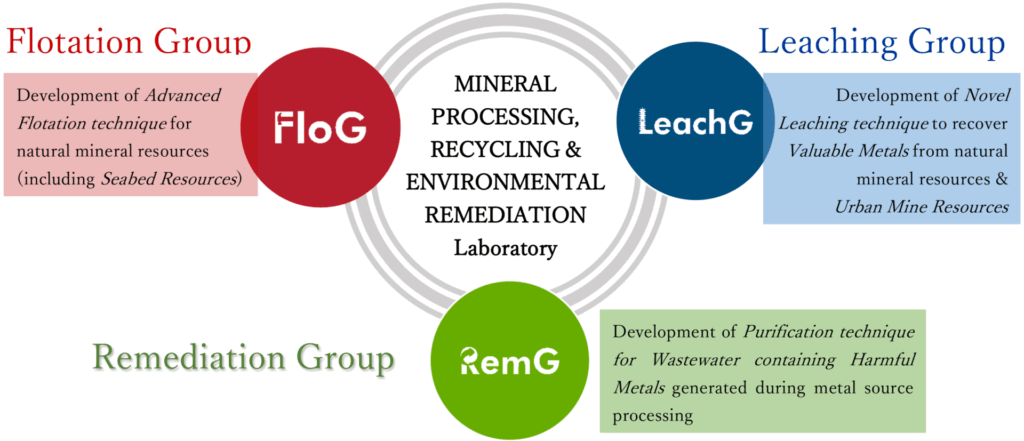
With a mission to create a “Sustainable Society,” our laboratory is involved in research from upstream to downstream of metal mineral processing, including Separation (Flotation), Hydrometallurgical Leaching, and Environmental Remediation.
Specifically, we have formed three groups (Flotation-G, Leaching-G, Remediation-G) to carry out fundamental and applied research. Under these circumstances, all groups often share concepts and methods to achieve the same ultimate goal, “the Creation of a Recycling-oriented Society”. Therefore, it is very important to acquire interdisciplinary, pioneering ideas and forward-thinking skills, beyond traditional academic fields’ boundaries.
For this purpose, each group holds a “Weekly Seminar” to share the progress of individual research within their group. In a “Friday Seminar”, all lab members take part in a “Journal Reading Session” where everyone takes turns to introduce international papers and discuss interdisciplinary topics.
| ▼ Theme of Flotation Group |
| ▼ Theme of Leaching Group |
| ▼ Theme of Remediation Group |
Research Themes for 2023
|
Flotation Group |
| We develop Advanced Flotation Techniques for the Beneficiation of Natural Mineral Resources, including Seafloor Resources. The latest approach proposes a novel ‘Green Flotation’ method based on the modification of mineral particles using harmless organic acids and nanoparticles.
■ Seafloor Hydrothermal Deposits (Complex Sulfide Ores) Project ■ Removal of Impurities (As, Mo) by Selective Flotation from Refractory Copper Ores ■ Elucidation of Sulfides Reaction Behavior Using Ultrafine Powder Electrode Method ■ Application of Flotation for Coal Upgrading ■ Development of Bio-Nanometal Generation Method as a New Flotation Reagent |
|
Leaching Group |
| In addition to Natural Mineral Resources (including Seafloor Resources), we are developing new hydrometallurgical techniques to recover valuable metals from Urban Mine Resources (such as Electronic Circuit Boards, Spent Catalysts, and Batteries). We propose novel leaching methods with low environmental impact, such as Bioleaching and Chemical-organic leaching.
■ Seafloor Hydrothermal Deposits (Complex Sulfide Ores) Project ■ Seafloor Cobalt-Rich Crust (CRC) Project ■ Refractory Cu-As Sulfide Ore Project ■ Indonesian Nickel Laterite Ore Project ■ Waste Electronic Board Recycling Project ■ Waste Catalyst Recycling Project ■ Bio-Nanoparticle Synthesis from Metal Leaching Solutions |
|
Remediation Group |
| We focus on the Development of Passive Treatment Technologies, particularly in the context of refining wastewater and mine drainage, to Remove Harmful Metals and Recover Valuable Metals. We refine the technology by constructing multifaceted and innovative reactions, incorporating bio-processes, hybrid processes, and waste recycling processes
■ Passive Treatment (PT) Project for Manganese Contamination ■ Arsenic Remediation Project ■ Bioscorodite Project ■ Arsenic Treatment at the Hishikari Mine Project |
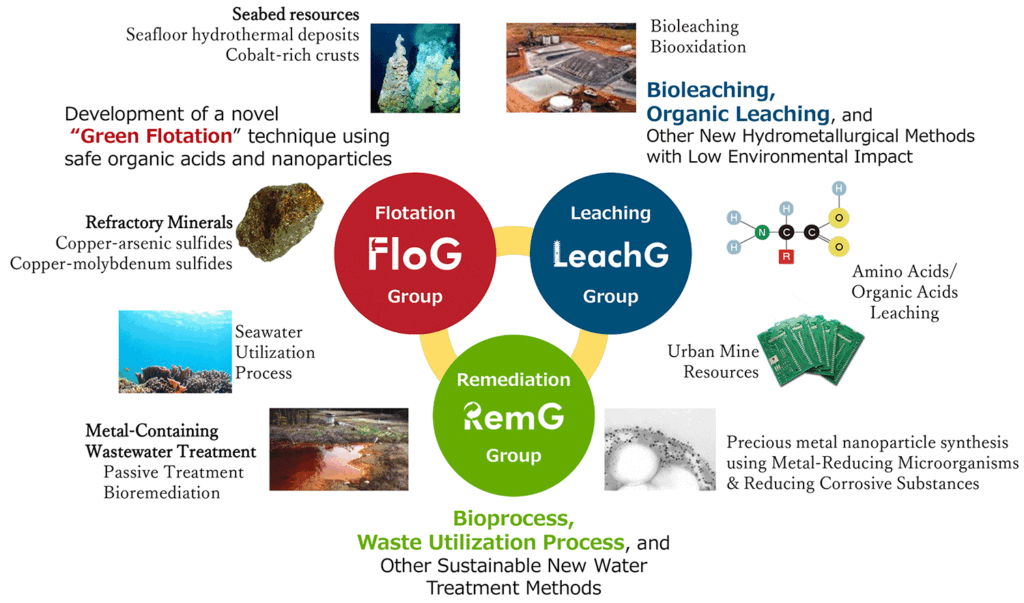
We carry out a wide range of studies, from fundamental and applied levels in the lab to practical scale and each theme progresses through a series of experiments and discussions. Our approach integrates various fields of knowledge, including Powder Engineering, Surface Chemistry, Electrochemistry, Mineralogy, Biotechnology, and Molecular Biology.
Within the constraints of finite resources, energy, and environmental limitations, we aim to contribute to a Sustainable, Recycling-oriented Society through comprehensive engineering. We strive to provide new insights into Metal Resources Processing and Environmental Remediation Technologies, which are essential to this goal.